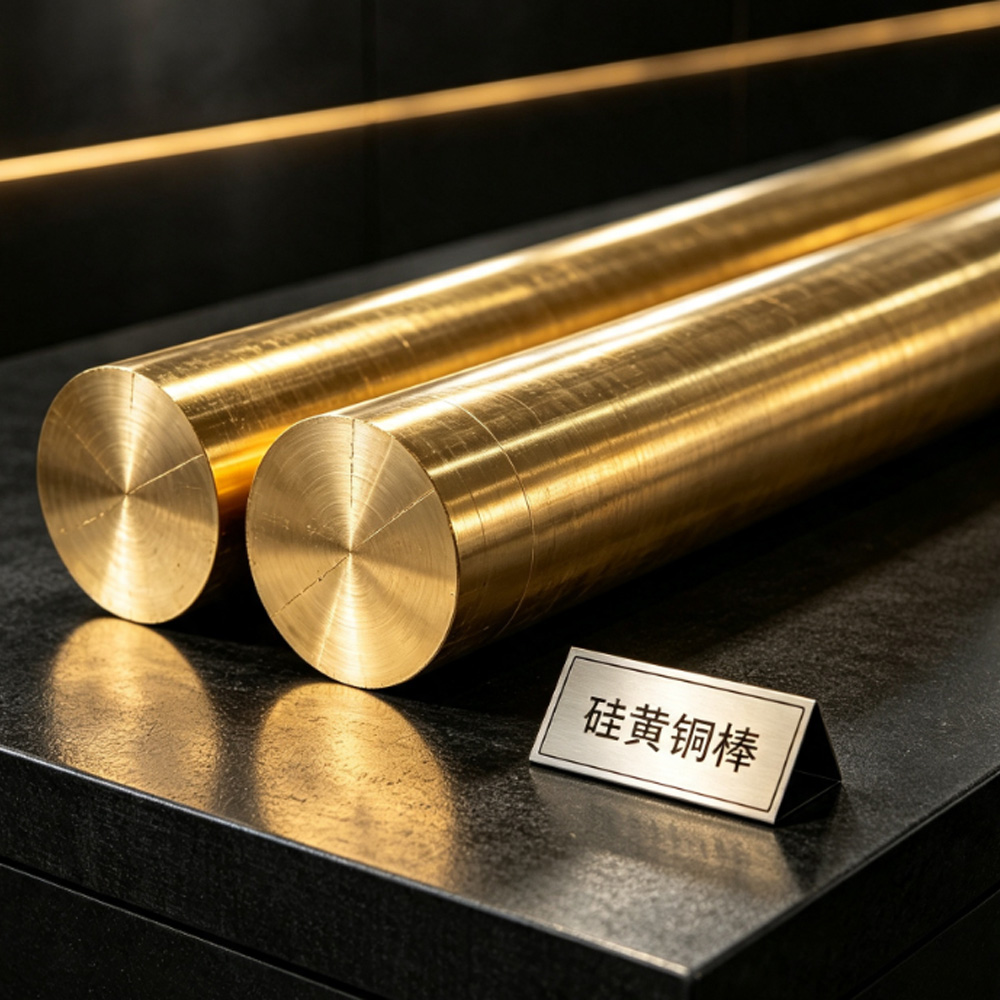
Silicon brass rod is brass made by adding silicon to copper zinc alloy. It has high corrosion resistance in both atmosphere and seawater, and its ability to resist stress corrosion cracking is higher than that of general brass. The silicon content is generally below 4%. The commonly used silicon brass 80Cu-17Zn-3Si can withstand hot pressure processing, has excellent corrosion resistance, a soft tensile strength of 300MPa, and an elongation rate of 58%. It is suitable for making ship parts, steam pipes, and water pipe fittings. The lead content of this alloy cannot exceed 0.01%, otherwise it will damage the thermoplasticity, especially the hot forging performance. 65Cu-31.5Zn-1.5Si-Pb is a lead containing silicon brass with high machinability, friction reduction, and corrosion resistance. It is mainly used as a substitute for wear-resistant tin bronze.
Characteristics of silicon brass rod
The performance of H65 silicon brass rod is between H68 rod and H62 rod, and it is cheaper than H68 rod. It has good mechanical properties, high strength and plasticity, and can withstand cold and hot pressure processing well. It has a tendency to corrode and crack. H65 brass is used to make small hardware, daily necessities, screws, and other components.
Brass is an alloy of copper and zinc. The simplest brass is a binary alloy of copper and zinc, known as simple brass or ordinary brass. Changing the zinc content in brass can result in brass with different mechanical properties. The higher the zinc content in brass, the higher its strength and slightly lower its plasticity. Brass used in industry has a zinc content of no more than 45%. Any higher zinc content will result in brittleness and deteriorate the alloy's properties. In order to improve certain properties of brass, brass with other alloy elements added on the basis of one element brass is called special brass. Common alloying elements include silicon, aluminum, tin, lead, manganese, iron, and nickel. Adding aluminum to brass can improve its yield strength and corrosion resistance, while slightly reducing its plasticity. Brass containing less than 4% aluminum has excellent comprehensive properties such as processing and casting. Adding 1% tin to brass can significantly improve its resistance to seawater and marine atmospheric corrosion, hence it is called "naval brass". Tin can also improve the cutting performance of brass. The main purpose of adding lead to brass is to improve machinability and wear resistance, and lead has little effect on the strength of brass. Manganese brass has good mechanical properties, thermal stability, and corrosion resistance; Adding aluminum to manganese brass can also improve its performance and result in castings with a smooth surface. Brass can be divided into two types of products: casting and pressure processing.
Silicon brass rod faucet breaks through new technology, ensuring health at the source
Starting from raw materials, reducing the harm of lead at the source, adding trace element silicon (Si) that is beneficial for human health absorption to brass, accurately proportioning the two materials to form a golden combination, and most importantly, the lead precipitation of the product is far below the world's strictest NSF standard and China's GB18145 regulation of 5 micrograms per liter. Silicon copper has the functions of acid resistance, alkali resistance, wear resistance, corrosion resistance, and does not release harmful substances. It has high corrosion resistance in both the atmosphere and seawater, and is therefore often used as a component for making ships and propellers. The silicone brass faucet has undergone 500000 valve core life tests, ensuring long-term use without water leakage. The aerator is made of silicone material, which is softer, easier to maintain and clean, and avoids clogging.
Shenzhen Yongtai'an Metal Materials Co., Ltd. is a large-scale high-quality supplier of imported tellurium copper, silicon brass rods, brass rods, purple copper wires, purple copper bars, and shaped copper raw materials in southern China. It is popular in Guangdong, Shenzhen, Dongguan, Huizhou, Guangzhou, Jiangsu and other regions.
|
grade |
Copper Cu |
Lead Pb |
Cadmium Cd |
Tin Sn |
Aluminum Al |
Nickel Ni |
Silicon Si |
Phosphorus P |
Iron Fe |
Manganese Mn |
Zinc Zn |
Total impurities |
|
HSi80-3 |
79-81 |
≤0.1 |
- |
- |
- |
- |
2.5-4.0 |
- |
≤0.6 |
- |
margin |
≤1.5 |
|
HSi75-3 |
73-77 |
≤0.1 |
≤0.2 |
≤0.2 |
- |
≤0.1 |
2.7-3.4 |
0.04-0.15 |
≤0.1 |
≤0.1 |
margin |
≤0.6 |
|
HSi62-0.6 |
59-64 |
≤0.09 |
≤0.6 |
≤0.6 |
≤0.3 |
≤0.2 |
0.3-1.0 |
0.05-0.4 |
≤0.15 |
- |
margin |
≤2.0 |
|
HSi61-0.6 |
59-63 |
≤0.2 |
- |
- |
- |
0.05-1.0 |
0.4-1.0 |
0.03-0.12 |
≤0.15 |
- |
margin |
≤0.3 |
Submitted successfully! We will contact you shortly.

 Chinese
 English